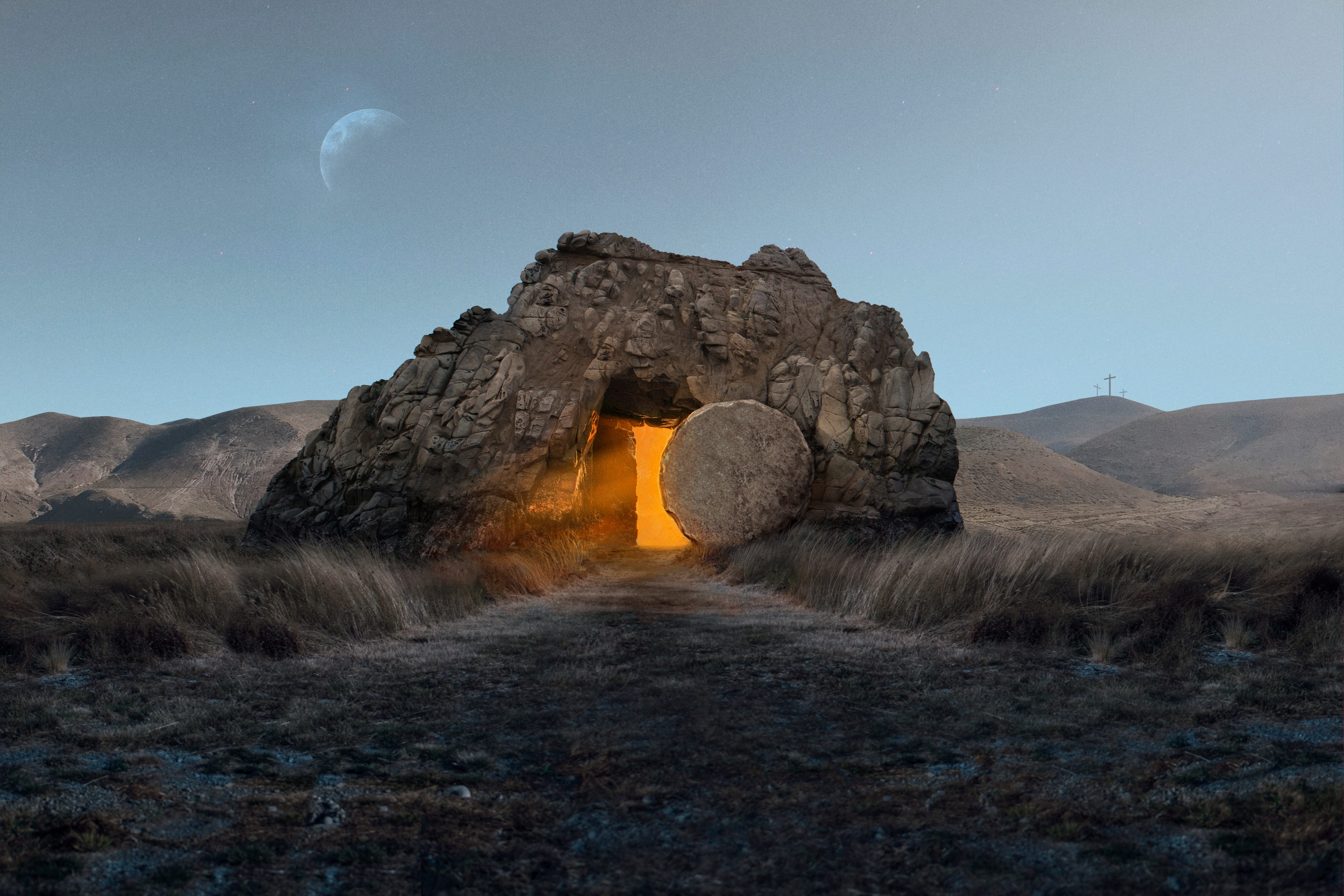
Post-Resurrection Notes (ii)
Does the Resurrection Answer Every Difficult Question About Our Faith... or Not?

The fact that life simply goes on after significant death and the experience of tragedy can be deeply demoralising. Recently, in Benue State, Nigeria, thousands of Christians have been gruesomely murdered for their faith. Villages razed. Men cut down in their fields. Women and children fleeing into forests in the dark. And by the following week, the world had largely moved on. Not because people are cruel. But because the human heart can only hold so much before it has to put something down to survive. We scroll past. We sigh. We say it is terrible. And the widows bury their dead alone.
This is the weight of suffering in our world. Not just that it happens, but that it happens and life continues as though it did not. The consolations we offer each other are very thin. The prayers feel honest but insufficient. And somewhere underneath all of it sits a question that tugs at the heart and will not let go: where is the resurrected Christ in this?
Because God is good and God is powerful, and that is why not fully understanding what He is doing in the middle of it can be so difficult to hold.
The suffering in this world is immense. And I will not pretend I have stopped struggling with why. But I found a pattern running through the whole of Scripture, and once you see it, it changes how you hold both your convictions and your unanswered questions. It starts with a fisherman on the Sea of Galilee.
More Reflections on Simon Peter
In the first instalment of Post-Resurrection Notes, we looked at the transformation of Peter. A simple fisherman, with no scribal training, not formed in the prestigious academies of Jerusalem. By every social and theological measure of his time, Peter had no business interpreting the Scriptures. And yet something powerful happens at Pentecost. The same man who once lacked interpretive grounding begins to weave together the Law, the Prophets, and the Psalms with precision and confidence. A fisherman doing what trained scholars spent years preparing for, and doing it in front of them.
Peter studied, hard and voraciously. Acts 6:4 tells us that when administrative disputes threatened to consume the apostles’ time, they protected the priority of prayer and the ministry of the word. But even if Peter had doubled his study efforts before the resurrection, he would not have reached the level of understanding that later astonished the teachers of the law. The study matters, but something more decisive happened.
Look at Luke 24:45:
“Then He opened their minds so they could understand the Scriptures.”
Something is worth pausing on here: after the resurrection, Jesus opens the minds of his disciples to understand the Scriptures. Now consider this. Jesus had three years with them — daily proximity, teaching, miracles — and yet Luke notes their minds were not opened then. He opens them after the resurrection.
Jesus himself says in Luke 24:44, “This is what I told you while I was still with you.” He had already taught them. They were aware of the content of the text, yet they did not understand. As John 20:9 notes, they still did not grasp from Scripture that He had to rise from the dead.
So Jesus taught them, knowing their understanding was still closed.
Why not open their understanding earlier?
John 16:12 offers a clue: “I have much more to say to you, more than you can now bear,” and “when the Spirit of truth comes, he will guide you into all truth.” The Spirit comes only after the cross and resurrection. The illuminating work follows the completed event.
The event first, then understanding.
The opening of minds in Luke 24 was not the next lesson in a curriculum. It was the first thing that became possible after the tomb was empty.
Here Is the Pattern
For hundreds of years, people read the Old Testament — the prophecies, psalms, and promises — and much of it was confusing. Prophets wrote things that did not fully make sense. Psalms described events that had not yet happened. Promises were given that no one could yet see fulfilled.
Now consider John the Baptist — but carefully.
Jesus himself declared him the greatest among those born of women. The highest possible character endorsement. And yet, from prison, John sent messengers to ask: “Are you the one, or should we expect someone else?”
This is striking. This same John had already received a direct sign from God about who Jesus is — the Spirit descending and remaining. He had seen it. He had declared Jesus as the Messiah publicly. So why did his conviction appear shaken? It was not the absence of revelation, but the strain of circumstances. Isolation, suffering, and the gap between what he had proclaimed and what his circumstances now felt like had become very wide.
And this is precisely the tension: even with revelation, the full weight of difficult circumstances can press hard against what we know and cause us to falter.
Now consider Peter after the resurrection.
Following the resurrection, the promised Holy Spirit had come, poured out at Pentecost just as Jesus said he would be. Peter now stands on the other side of that event, inhabited by that promise.
But Peter is also laden with difficult circumstance, not so different from John. Threat of death. Institutional opposition. Isolation. The same kinds of forces that had pressed against John in his prison cell now press against Peter in the open streets of Jerusalem and in the courts of the powerful.
But his conviction does not collapse.
And I honestly cannot help but sit with that. Peter stands on the other side of the resurrection, with the promised Spirit now dwelling within him, and when the pressure comes, something holds.
Could it be that what John carried about Jesus, Peter now carries within him?
Could it be that the event didn’t just clarify the text of the Old Testament, it changed the nature of the witness?
That is the power of an event.
Here Is a Question
And if that is true, then a pattern becomes visible. If it was not study alone that changed Peter — not willpower, not character — but the event, and what followed. If that event did not simply give him new information, but made him a new kind of person, capable of carrying things John could only gesture toward from a distance.
Then the question I cannot escape is this: if one event did all of that, what might another do?
We read the New Testament today and encounter questions it raises but does not fully answer. If I place the resurrection in front of the question of why a tender baby, who has brought joy to their parents, dies a painful death at 18 months old, what answer does it give me? If I place it in front of why animals suffer under the brutal process of natural selection, what answer does it give me?
This boggles my mind. But it also led me to this pattern in Scripture that gives me a living hope — Partial understanding, then an event, then clarity.
The Dark Glass
Even Paul, trained by the finest rabbi of his day, who had a direct encounter with the risen Jesus on the road to Damascus, even Paul felt this. After explaining one of the deepest mysteries in all of Scripture, he did not finish with a neat summary. He finished with this:
“Oh, the depth of the riches of the wisdom and knowledge of God! How unsearchable his judgments and how inscrutable his ways!” (Romans 11:33)
Unsearchable?
That is not a man who has run out of intelligence. That is a man who has reached the edge of what can currently be seen, and is honest enough to say so.
Paul also captures this with one of the most vivid images in the whole Bible:
“For now we see through a glass darkly, but then face to face. Now I know in part, but then I shall know fully, even as I am fully known.” (1 Corinthians 13:12)
Paul is not saying we know nothing. He is saying we know in part. And notice how the shift from partial to full knowing happens. It is not gradual. It is not, one day you will read enough books and eventually it will all make sense. It is tied to an encounter.
Face to Face.
The pattern holds: partial understanding, then an event, then clarity.
It happened at the resurrection. I put all of my faith in this, that it will happen again. When we see Him. Face to Face.
Oh, all these difficult questions, they await an event. The New Testament refers to it as the Second Coming of Christ — The Parousia, when the answers to every hard question will be given, when every tear will be wiped away. And what that event produces will not be compensation. The resurrection did not compensate the disciples for their loss and grief. If anything, they suffered more physically. Acts 5:41 records them leaving the Sanhedrin rejoicing because they had been counted worthy of suffering for His name. Romans 8:11 tells us the same Spirit that raised Jesus from the dead now lives in the believer. What the disciples experienced was a TRANSLATION. An injection of living hope that changed them entirely.
Just as the resurrection brought illumination and clarity to a once sealed Old Testament and flooded the disciples with conviction and joy, what joy do you imagine will come when Christ returns for His bride? When we know fully, I tell you, it cannot be truly imagined.
There will most certainly be another event. And then we will know fully.
A new heaven, a new Jerusalem, the Second Coming of Christ.
So About Questions We Cannot Answer…
Firstly, here is an important distinction worth making. Not all unanswered questions are the same kind of unanswered.
The first category: questions already answered by the resurrection that diligent study can unlock. Is Jesus the Messiah promised in the Old Testament? Is He the ONLY way to the Father? The resurrection answers this, and Peter’s Pentecost sermon demonstrates exactly how, weaving together Psalm 16, Psalm 110 and Joel 2 in light of the empty tomb. For these questions, the lights are already on. What stands between us and the answer is the willingness to open the scroll and study. Peter admonishes us in his first epistle to always be ready to give a reason for the hope we carry. If we are responding to every hard question with “we know in part” without having done the work, that is not humility. It is laziness dressed as theology.
The second category: questions the New Testament itself raises but does not fully resolve, which await the Parousia. Why does a good God permit the suffering of innocents? Why does the fate of the unevangelised remain contested after two thousand years of serious scholarship? These questions await an event.
The resurrection already proved the pattern. What was sealed got opened. What was confusing became clear. And this is why we have a living hope.
This is the Parousia, the Second Coming of Christ. Not just an event of judgment, but an event of full revelation. The moment the fog clears. Where we see Him, face to face.
And if Easter morning is any indication, it is that Jesus is coming for His bride.
While We Wait
As we wait, here is something worth holding practically, because how we respond to these questions in the meantime matters as much as what we believe about them.
When John the Baptist sent his disciples to ask Jesus “Are you the one, or should we expect someone else?”, notice carefully how Jesus responded. He did not say yes. He did not open the scrolls and walk them through the Messianic prophecies. He said this:
“Go back and report to John what you hear and see: the blind receive sight, the lame walk, those who have leprosy are cleansed, the deaf hear, the dead are raised, and the good news is proclaimed to the poor.” (Matthew 11:4-5)
Jesus pointed to tangible, observable, present-tense evidence. He essentially said: look at what is happening in front of you. He did not argue His way to the answer. He made no mention of the death He would die as prophesied by the prophets and tell John it would happen in time. He pointed to the reality of what God was doing and invited John to draw his own conclusion.
This is a framework worth holding. When someone comes with a hard question, we do not always need to have the complete theological answer. Sometimes the most honest and powerful response is to do what Jesus did, point to what is already visible and invite the questioner to look carefully.
So when someone asks me why a good God allows innocent suffering, I do not have a complete answer. But I can point to what I do see. I see a God who did not watch suffering from a distance but entered it. Who was Himself acquainted with grief. Who wept at a graveside. Who was beaten, mocked, and executed.
Whatever God is doing in the middle of suffering, He is not absent from it. He is in it. And the resurrection tells me that He does not leave things in the condition He finds them. Death was the final word, until it wasn’t. That same power, Romans 8:11 tells us, is still at work in the world.
Oh, I’ll tell about the fourth man in the fire. I’ll point to a God who entered the very worst of what this world produces, and came out the other side. And I can invite the questioner to sit with that honestly.
The Proclamation
Now contrast Jesus’ response to John the Baptist about whether He was the Messiah with what He tells the disciples after the resurrection. In Luke 24:44-45, He opens their minds and tells them plainly: everything written about me in the Law of Moses, the Prophets and the Psalms has been fulfilled, saying plainly that I AM.
Pre-resurrection, He pointed to evidence and invited a conclusion. Post-resurrection, the event had occurred, and He stated the truth directly. The time for inference was over. The time for proclamation had come.
This is our guide. For questions that await the Second Coming, we point honestly to what we can see and we sit with the questioner in the uncertainty, as fellow travellers, not as people with all the answers. For questions the resurrection has already answered, we proclaim with the same overwhelming joy Jesus carried in His appearances to the disciples after the resurrection.
I’d end by saying a prayer for every disciple of Christ reading this, that when we are asked these hard questions, we will present this living hope. I pray we share it with the same warmth Jesus used to speak to the apostles walking down the road to Emmaus, that burned their hearts, and with the conviction that Peter carried when he stood before the crowd in Jerusalem and told them the seemingly impossible news of a resurrection from the dead, a stumbling block to those who honour the laws of physics above the laws of God.
Yet Peter said it boldly. And we will say it too, boldly, trusting that the same God who met the multitude of searching hearts that heard Peter on the day of Pentecost will meet anyone searching and reading this, and will also plant within us all a deep longing and desire for the glorious Second Coming of our Lord Jesus.
Blessed be God, for it is by His great mercy that we have been given a living hope through the resurrection of our Lord Jesus Christ.
Amen.